
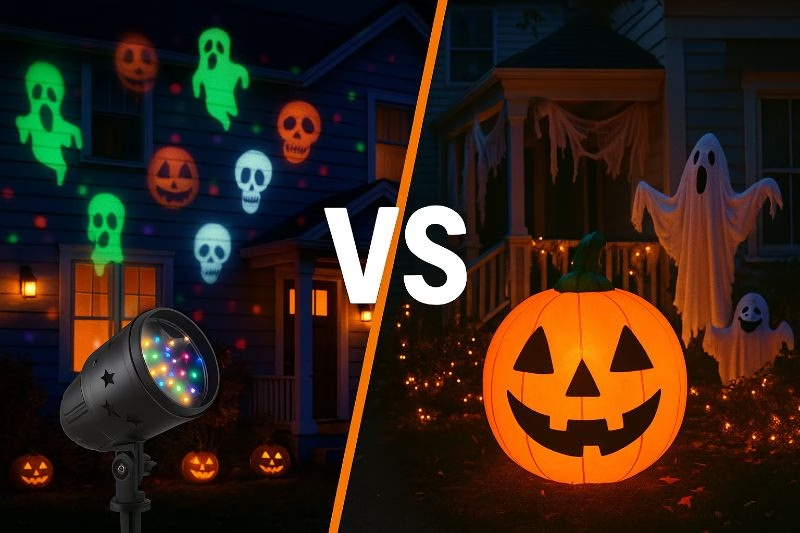
Halloween projection lights and traditional decorations can both transform a house after dark, but they solve very different decorating problems.
Projection lights are fast, compact, and capable of covering a large wall with very little installation. Traditional decorations take more time, but they give you much more control over depth, placement, texture, and the way visitors experience the display up close.
For many homes, the best result is not choosing one or the other. It is using projection lighting for broad background effects and traditional decorations for the parts of the display people actually walk past.
This guide compares the two approaches by setup time, coverage, cost, storage, weather exposure, visual impact, and flexibility.
What Are Halloween Projection Lights?
Halloween projection lights use a compact projector to cast images, patterns, colors, or animated effects onto a surface.
Depending on the model, the projected effect may include:
- Ghosts
- Pumpkins
- Bats
- Skulls
- Spider webs
- Moving dots or shapes
- Color washes
- Animated Halloween scenes
One projector can sometimes cover a garage door, exterior wall, fence, or large section of a house.
What Counts as Traditional Halloween Decorations?
Traditional Halloween decorations include physical props and lights arranged throughout the yard or around the house.
Examples include:
- String lights
- Pathway lights
- Spotlights
- Pumpkins
- Skeletons
- Inflatables
- Tombstones
- Spider webs
- Lanterns
- Window silhouettes
- Hanging ghosts
These decorations create a more three-dimensional display because visitors see actual objects rather than images projected onto a surface.
Projection Lights Are Much Faster to Set Up
Setup speed is probably the biggest advantage of projection lights.
A basic projector setup may only require:
- Positioning the projector
- Aiming it at the target surface
- Adjusting the projection size or angle
- Connecting power
That is much faster than hanging lights across a roofline, wrapping trees, placing dozens of props, or installing individual pathway lights.
If you want a visible Halloween display but have limited time, projection lights can produce a dramatic change with relatively little work.
Traditional Decorations Create More Depth
Traditional decorations usually look more convincing when viewed from close range.
A projected ghost may look impressive from across the street, but a real skeleton beside the walkway creates a much stronger experience for someone walking toward the front door.
Physical decorations allow you to create:
- Foreground elements
- Background elements
- Silhouettes
- Shadows
- Different heights
- Multiple viewing angles
This gives the display more depth than a single projected surface.
Projection Lights Cover Large Areas Efficiently
If you have a large blank exterior wall or garage door, projection lighting can be very efficient.
Instead of buying several strings of lights or many separate decorations, one projector can provide a large visual effect.
Projection works especially well on:
- Garage doors
- Flat siding
- Large exterior walls
- Fences
- Interior walls visible through windows
The smoother and less interrupted the surface, the clearer the projected image tends to appear.
Projection Lights Struggle on Uneven Surfaces
The biggest limitation of projection lighting is that the image depends heavily on the surface.
Projection may look distorted or fragmented when aimed across:
- Trees
- Dense shrubs
- Highly textured stone
- Deep architectural details
- Multiple windows
- Columns
- Irregular rooflines
Traditional lights and props are much easier to adapt to complicated architecture and landscaping.
Traditional Decorations Offer More Creative Control
With physical decorations, you decide exactly where every element goes.
You can use orange pathway lighting in one area, purple uplighting on a tree, a skeleton near the porch, and pumpkins around the steps.
That level of control is harder to achieve with one projected image.
If you enjoy designing the display as a complete scene, traditional decorating gives you much more flexibility.
For color planning, see our guide to purple and orange Halloween lighting.
Projection Lights Are Easier to Store
Storage is another major advantage.
A projector, stake, power adapter, and a few accessories may fit into one small box.
A traditional display can quickly require multiple storage containers for:
- Light strings
- Extension cords
- Inflatables
- Skeletons
- Large props
- Wreaths
- Pathway decorations
If storage space is limited, projection lighting is much easier to manage between seasons.
Traditional Decorations Can Be More Durable Over Time
Simple physical decorations can remain useful for many years because there are fewer electronic components involved.
A plastic skeleton, lantern, or weather-resistant pathway light may continue working even if the rest of your display changes.
Projection lights rely on:
- Internal LEDs
- Motors in some animated models
- Control electronics
- Power adapters
- Weather seals
If one important component fails, the entire projected effect may stop working.
Weather Matters More With Projection Equipment
Outdoor-rated projection lights can be designed for exterior use, but placement still matters.
Rain, standing water, strong wind, and exposed electrical connections can all create problems if the equipment is installed carelessly.
Traditional decorations also need appropriate weather resistance, but individual pieces can often be positioned more flexibly under porches, eaves, trees, or covered areas.
Whatever you use, check the manufacturer’s outdoor-use rating before installation.
Wind Can Affect Both Approaches Differently
Projection lights are relatively compact, but the projector itself needs to remain stable.
If the stake or mounting position shifts, the projected image may move away from the intended surface.
Traditional decorations have different wind concerns.
Lightweight props, inflatables, hanging ghosts, and artificial spider webs may move or detach if they are not secured properly.
So neither approach is automatically better in windy conditions. They simply require different kinds of installation.
Which Is More Affordable?
The answer depends on the size of the display you are comparing.
A single Halloween projector may replace several smaller decorative items when you need to cover a large surface.
That can make projection relatively economical for a simple display.
Traditional decorating can also be inexpensive if you start with:
- A few string lights
- Reusable pumpkins
- One spotlight
- Simple silhouettes
- Battery-powered LEDs
The cost increases when you start adding many animated props, inflatables, smart lights, and large outdoor decorations.
Projection Lights Work Well for Last-Minute Decorating
If Halloween is only a few days away and the house still looks undecorated, projection lights are one of the quickest ways to create a visible display.
They are particularly useful for renters or anyone who does not want to attach decorations to the roof, siding, or gutters.
That makes them practical for temporary setups.
Traditional Decorations Are Better for Walk-Through Displays
If visitors will walk through the yard, physical decorations become much more important.
A projection may establish the atmosphere from a distance, but trick-or-treaters are more likely to notice:
- Pathway lights
- Pumpkins
- Tombstones
- Skeletons
- Lanterns
- Window scenes
- Decorated trees
These elements make the display feel immersive rather than simply visible.
Projection Lights Are Better for Large Blank Walls
A garage door is almost an ideal projection surface.
It is large, relatively flat, and usually visible from the street.
A projector can turn the entire door into:
- A moving ghost scene
- A swarm of bats
- A pumpkin animation
- A spider-web background
- A shifting purple or orange pattern
Achieving the same coverage with physical decorations would usually require more equipment and installation time.
Traditional Lighting Is Better for Trees and Landscaping
Trees, bushes, pathways, and garden areas benefit more from direct lighting than from projection.
Use:
- Uplights on trees
- String lights in shrubs
- Pathway lights along walkways
- Small spotlights behind props
This gives the landscaping real dimension.
See our Halloween outdoor lighting ideas for a complete yard-planning approach.
Which Looks Better From the Street?
Projection lights can be very effective when the main goal is curb appeal.
Large animated images are easy to notice from a distance.
Traditional decorations can also look excellent from the street, but smaller details may disappear unless they are illuminated properly.
If most people will only see your display while driving past, projection lighting becomes more attractive.
Which Looks Better Up Close?
Traditional decorations usually have the advantage.
Someone standing ten feet from your porch can see texture, shadows, movement, depth, and the relationships between physical objects.
A projected image remains a flat light effect even when it is visually impressive.
For homes with heavy trick-or-treat traffic, traditional decorations often provide the better close-range experience.
Do Projection Lights Use Less Power?
Power use varies by product, so there is no universal answer.
A compact LED projector may consume less electricity than a large display containing many strings of lights, inflatables, and spotlights.
But comparing one projector against one LED string light could produce a completely different result.
Check the wattage of the actual products you plan to use if energy consumption matters to you.
Battery-Powered Decorations vs Plug-In Projectors
Many Halloween projectors require a plug-in power source.
Traditional decorations give you more options because small lights and props are widely available in battery-powered versions.
Battery lighting is particularly useful for:
- Pumpkins
- Wreaths
- Windows
- Small props
- Areas away from outlets
For a deeper comparison, read our battery vs plug-in Halloween lights guide.
Traditional Decorations Are Easier to Expand Gradually
You do not need to build a full Halloween display in one season.
Traditional decorations are easy to collect gradually.
You might start with:
- Pathway lights
- A few pumpkins
- One purple spotlight
- A skeleton
The next year, you can add window lighting, more props, and another tree or wall section.
This incremental approach works especially well when you want the display to become more elaborate over time.
Projection Lights Can Change Themes Quickly
Some projectors include multiple slides, patterns, or modes.
That makes it easy to change the look of the display without changing the hardware.
You may be able to switch from ghosts to pumpkins or from a static image to a moving pattern within a few seconds.
Traditional decorations require physically replacing or rearranging items to achieve the same kind of theme change.
Can You Combine Projection Lights With Traditional Decorations?
Yes, and this is often the strongest approach.
Use projection lighting for the background and physical decorations in the foreground.
For example:
- Project moving bats across the garage door.
- Place pumpkins and pathway lights in front of it.
- Add a purple spotlight to a nearby tree.
- Place a skeleton near the walkway.
The projection provides scale while the physical decorations provide depth.
A Good Hybrid Setup for a Small House
A simple hybrid display might include:
- One Halloween projector aimed at the garage door or exterior wall
- Orange pathway lights leading to the porch
- Battery-operated LEDs inside pumpkins
- One purple spotlight aimed at a tree
- A physical skeleton or ghost near the entrance
This requires much less setup than a fully traditional display but still feels layered when viewed up close.
A Hybrid Setup for a Larger Yard
For a bigger property, assign different roles to each type of decoration.
House Background
Use projection lighting across one large exterior surface.
Landscape
Use spotlights, uplighting, and string lights around trees and shrubs.
Walkway
Use physical pathway lights and decorations where visitors can see them clearly.
Porch
Use pumpkins, skeletons, lanterns, and smaller detailed props.
This avoids trying to make one technology do everything.
Projection Lights vs Traditional Decorations: Quick Comparison
| Factor | Projection Lights | Traditional Decorations |
|---|---|---|
| Setup speed | Very fast | Usually slower |
| Large-area coverage | Excellent | Requires more items |
| Close-up detail | Limited | Excellent |
| Storage | Compact | Can require significant space |
| Creative control | Moderate | High |
| Best surfaces | Flat walls and garage doors | Almost anywhere |
| Depth | Mostly flat | Three-dimensional |
| Quick theme changes | Easy on compatible models | Requires rearranging decorations |
Which Approach Should You Choose?
Choose projection lights if you:
- Want fast setup
- Have a large blank wall or garage door
- Have limited storage space
- Want a noticeable effect from the street
- Do not want to install many individual decorations
Choose traditional decorations if you:
- Enjoy building detailed displays
- Expect many trick-or-treaters
- Want an immersive yard or porch
- Need to decorate trees and landscaping
- Want full control over placement and color
Choose both if you want the scale of projection lighting without sacrificing the depth and detail of physical decorations.
Final Thoughts
Halloween projection lights are excellent at doing one thing quickly: covering a large area with a dramatic visual effect.
Traditional Halloween decorations are better at creating a detailed environment that people can explore up close.
If your priority is speed, storage, and curb appeal, projection lighting has clear advantages. If your priority is depth, creativity, and the trick-or-treat experience, traditional decorating offers more possibilities.
For many homes, a hybrid setup gives you the strongest result: projection for the background, traditional decorations for the foreground, and strategic lighting tying everything together.
For more seasonal ideas, browse our Event Lighting guides.
One Comment