
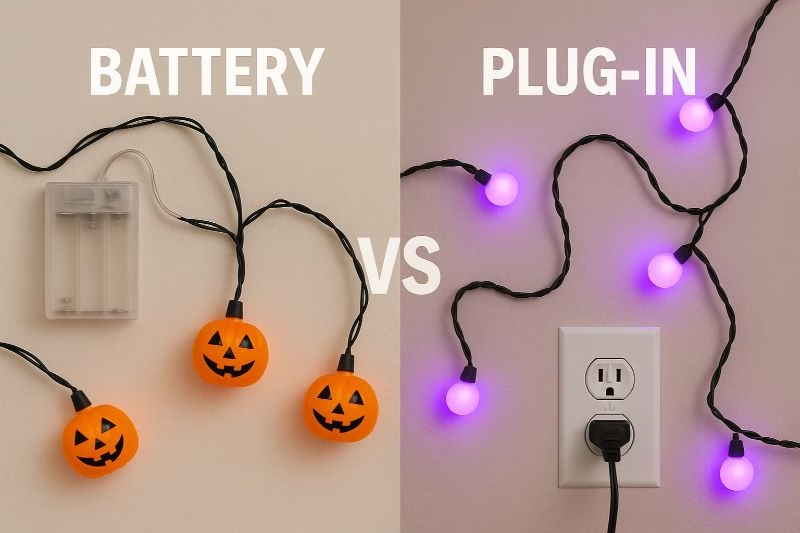
Battery-powered and plug-in Halloween lights can both work well, but they are better suited to different parts of a display.
Battery lights are convenient when you want freedom from outlets and extension cords. Plug-in lights are usually better for larger displays, brighter fixtures, projectors, and areas where the lights will run for several hours every night.
The best choice depends on where the lights will go, how long they need to operate, how much brightness you need, and how much cable management you are willing to deal with.
This guide compares battery-powered and plug-in Halloween lights by setup, runtime, brightness, weather exposure, safety, maintenance, and practical use around the home.
Battery-Powered Halloween Lights: The Main Advantage Is Flexibility
Battery-powered lights can be placed almost anywhere because they do not need to stay close to an outlet.
That makes them especially useful for:
- Pumpkins
- Wreaths
- Small props
- Windows
- Table decorations
- Railings
- Small shrubs
- Hanging decorations
- Areas where running a cord would be awkward
They are also useful when the decoration needs to move or when you do not want visible cables crossing part of the display.
Plug-In Halloween Lights Are Better for Larger Displays
Plug-in lights are usually the practical choice when you need more power or longer continuous operation.
They work well for:
- Long string-light runs
- Projection lights
- Outdoor spotlights
- Floodlights
- Large inflatables
- Whole-house displays
- Large trees
- Multiple connected light sets
If your display includes several high-output fixtures, battery power quickly becomes less convenient.
Which Is Easier to Install?
For a single decoration, battery lights are usually easier.
You can install the batteries, place the light where you want it, and turn it on without planning a route back to an outlet.
Plug-in lights require more planning because you need to think about:
- Outlet location
- Extension cord length
- Outdoor-rated connections
- Walkways
- Moisture exposure
- How many devices share the same circuit
For a larger display, however, plug-in lighting may actually become simpler because you do not have dozens of separate battery compartments to maintain.
Battery Lights Are Better for Small Props
Small Halloween props often do not need much power.
A short LED string or compact puck light may be enough to illuminate:
- A jack-o’-lantern
- A skull
- A lantern
- A ghost decoration
- A wreath
- A small tabletop scene
Using a long extension cord for one small decoration usually creates more inconvenience than necessary.
Plug-In Lights Usually Offer Better Brightness
Battery-powered LEDs can be surprisingly bright, but plug-in lighting is generally better when you need sustained high output.
This matters for:
- Lighting a large exterior wall
- Uplighting a mature tree
- Running a Halloween projector
- Illuminating a large porch
- Covering a wide yard
For small decorative effects, battery-powered lights are usually bright enough. For larger lighting jobs, plug-in fixtures tend to be more practical.
Runtime Is the Biggest Battery Limitation
Battery life varies widely depending on the light, battery type, brightness setting, and operating mode.
Short strings of efficient LEDs may run for many evenings, while brighter lights can drain batteries much faster.
If you use battery lights, look for models with:
- Built-in timers
- Low-power LED bulbs
- Multiple brightness settings
- Easy-access battery compartments
A timer is particularly useful because it prevents the lights from running all night unnecessarily.
Plug-In Lights Are Better for Long Evening Use
If your Halloween display runs from sunset until late evening every night, plug-in lighting becomes more convenient.
You do not have to monitor remaining battery life, replace cells frequently, or worry about one decoration going dark before the others.
A timer or smart plug can automate the entire schedule.
Battery Lights Make Cable Management Much Easier
Extension cords can quickly become one of the messiest parts of a Halloween setup.
Battery lighting eliminates the cord entirely.
This is particularly useful for decorations located:
- In the middle of the yard
- On a fence
- Around a gate
- Inside a wreath
- On a table
- High on a porch
For areas where people walk, reducing the number of cords can also make the setup easier to manage safely.
Plug-In Lights Can Be Cleaner Than Batteries in One Large Zone
Although plug-in setups involve cords, they can be more organized when many decorations are close together.
For example, a porch with several strings of lights, a spotlight, and a projector may be easier to manage from one properly planned electrical source than with separate battery packs on every item.
Which Is Better for Pumpkins?
Battery-powered LEDs are generally the more convenient choice for pumpkins.
They can sit inside the pumpkin without an electrical cord coming out through the display.
Small battery-operated candles or flickering LEDs also produce a candle-like effect without using an open flame.
This is one of the clearest situations where battery power makes more sense than plug-in lighting.
Which Is Better for Halloween Wreaths?
Battery lights are usually easier for wreaths because doors often move and may not have a convenient nearby outlet.
A small battery pack can be hidden behind the wreath or among the decorations.
Look for a timer so the wreath does not need to be manually switched on every evening.
Which Is Better for Trees?
It depends on the size of the tree.
For a small potted tree or decorative shrub, battery string lights can work well.
For a large tree, plug-in lighting is generally better because:
- More lights are required
- Runtime is longer
- Higher output may be needed
- Replacing batteries can become inconvenient
If you are using uplights rather than wrapping the branches, a plug-in outdoor spotlight is usually the more practical option.
Which Is Better for Pathway Lights?
Battery pathway lights are useful when you want temporary Halloween-specific designs such as pumpkins, ghosts, or skulls.
They are easy to place and remove after the holiday.
Plug-in pathway lighting can make sense for longer runs where several lights need to remain consistently bright.
Whichever option you use, keep fixtures outside the main walking path.
Which Is Better for Projection Lights?
Plug-in power is generally the better option for Halloween projectors.
Projection equipment needs more continuous power than small decorative LEDs, and a weak battery can reduce runtime at exactly the time you want the display operating.
For more on projection displays, see our Halloween projection lights vs traditional decorations guide.
Which Is Better for Window Displays?
Both can work.
Battery lights are convenient for small window silhouettes, wreaths, and decorative scenes.
Plug-in lights make more sense for:
- Large curtain-light displays
- Long LED strips
- Multiple windows
- Displays that run for many hours
Because indoor outlets are usually easier to access, plug-in lighting is less inconvenient around windows than it is in the middle of a yard.
Weather Resistance Matters More Than the Power Source
A light being battery-powered does not automatically mean it is safe for outdoor use.
Likewise, not every plug-in light is designed for rain or damp conditions.
Check whether the product is specifically rated for outdoor use.
Pay particular attention to:
- Battery compartments
- Power adapters
- Plug connections
- Controllers
- Extension-cord connections
These areas may be more vulnerable to moisture than the LED bulbs themselves.
Battery Compartments Need Protection Too
Battery packs are easy to forget because they are often hidden behind decorations.
If the light is used outdoors, the battery compartment needs appropriate weather protection.
Do not assume that wrapping a non-outdoor battery box in a plastic bag turns it into a properly outdoor-rated product.
Plug-In Lights Require More Electrical Planning
With plug-in Halloween lighting, pay attention to how everything is connected.
Use equipment suited to the environment and avoid improvised electrical connections.
Outdoor Halloween setups commonly involve:
- Extension cords
- Timers
- Power strips
- Projectors
- Inflatables
- Multiple light strings
The more equipment you add, the more important it becomes to plan the electrical layout rather than connecting items randomly.
Do Battery Lights Cost More to Run?
The answer depends on how often you replace the batteries.
LED battery lights use relatively little energy, but disposable batteries can become an ongoing expense if the lights run for many hours every night.
Rechargeable batteries can reduce that recurring cost, but they add charging and maintenance.
Plug-in LEDs use electricity directly, which can be easier to manage for longer displays.
Actual operating cost depends on wattage, runtime, local electricity rates, and battery usage.
Rechargeable Halloween Lights: A Middle Ground
Rechargeable lights can offer some of the freedom of battery-powered products without relying on disposable batteries.
They are useful for:
- Portable lanterns
- Small spotlights
- Table decorations
- Window displays
- Temporary props
The trade-off is that you need to remember to recharge them.
For a display that runs every night, that may become inconvenient if several fixtures need charging separately.
Battery Lights Are Easier for Renters
Renters may have limited access to exterior outlets or may want to avoid installing permanent electrical hardware.
Battery-powered lighting makes temporary decorating much easier because it does not depend on the electrical layout of the property.
It also works well on balconies and apartment doors where running an extension cord may not be practical.
Plug-In Lighting Works Better With Timers and Smart Controls
Both battery and plug-in lights can include timers, but plug-in lighting is particularly easy to automate with external controls.
A plug-in timer or compatible smart plug can turn several decorations on and off at the same time.
This is useful for larger displays where manually controlling each item would be tedious.
Battery Lights Are Easier to Hide
One visual advantage of battery-powered lights is that there is no visible cord running back to a building.
That can make Halloween props look more convincing.
For example, a glowing ghost hanging from a tree looks cleaner when there is no obvious extension cord leading to it.
Plug-In Lights Are Better for High-Impact Color Effects
If you want to wash an entire wall in purple or orange light, use a strong spotlight or floodlight.
These higher-output fixtures are usually easier to run from mains power.
For ideas on using those colors together, see our purple and orange Halloween lighting guide.
Use Both Instead of Choosing Only One
Many Halloween displays work best with a combination.
Use plug-in power for the large, power-hungry parts of the display and battery lights for individual decorations.
For example:
- Plug-in: projectors, floodlights, large string lights, inflatables
- Battery: pumpkins, wreaths, lanterns, small props, remote decorations
This keeps the electrical setup manageable without limiting where you can place smaller effects.
A Simple Hybrid Halloween Setup
For a typical front yard, you might use:
- A plug-in purple spotlight aimed at a tree
- A plug-in projector on the garage door
- Battery-operated LEDs inside pumpkins
- Battery pathway decorations along the walkway
- Battery lights inside a front-door wreath
This gives the high-output fixtures reliable power while keeping smaller decorations flexible.
Battery vs Plug-In Halloween Lights: Quick Comparison
| Factor | Battery-Powered | Plug-In |
|---|---|---|
| Placement flexibility | Excellent | Depends on outlet access |
| Installation | Very easy for small items | Requires cable planning |
| Brightness | Good for smaller decorations | Better for high-output lighting |
| Runtime | Limited by batteries | Continuous while powered |
| Cable clutter | Minimal | Can require extension cords |
| Best for projectors | Usually not ideal | Yes |
| Best for pumpkins | Yes | Usually unnecessary |
| Large displays | Can become difficult to maintain | Usually more practical |
When Battery-Powered Lights Make the Most Sense
Choose battery-powered Halloween lights when:
- The decoration is small
- No outlet is nearby
- You want to avoid extension cords
- The light only needs modest brightness
- You need the decoration to be portable
- You are decorating pumpkins, wreaths, or small props
When Plug-In Lights Make the Most Sense
Choose plug-in Halloween lights when:
- You need strong brightness
- The display runs for several hours every night
- You are powering a projector or inflatable
- You are lighting a large tree or wall
- You have several connected light strings
- You want everything controlled by one timer or smart system
Halloween Lighting Safety
Regardless of the power source, use decorative lighting according to its intended environment.
- Use outdoor-rated lighting for exposed outdoor installations.
- Inspect wires, battery compartments, plugs, and housings before use.
- Keep electrical equipment away from standing water.
- Keep cords away from busy walkways whenever possible.
- Use suitable outdoor extension cords for exterior plug-in equipment.
- Do not overload electrical connections.
- Keep lighting away from easily combustible decorations and materials.
- Turn off electrical decorations when they are unattended or when you go to bed.
Also keep the route to your door visible. A Halloween display can be dark and atmospheric without hiding steps or creating obstacles for visitors.
Final Thoughts
Battery-powered Halloween lights are best when flexibility matters more than raw power. They are excellent for pumpkins, wreaths, small props, and decorations placed away from outlets.
Plug-in lights are better when you need brightness, long runtime, or enough power for projectors, floodlights, inflatables, and larger outdoor displays.
For most homes, the strongest setup uses both. Plug in the large fixtures and use battery-powered LEDs wherever a cord would make the display awkward.
For more ideas on putting the complete display together, see our Halloween outdoor lighting ideas or browse our Event Lighting guides.
One Comment