
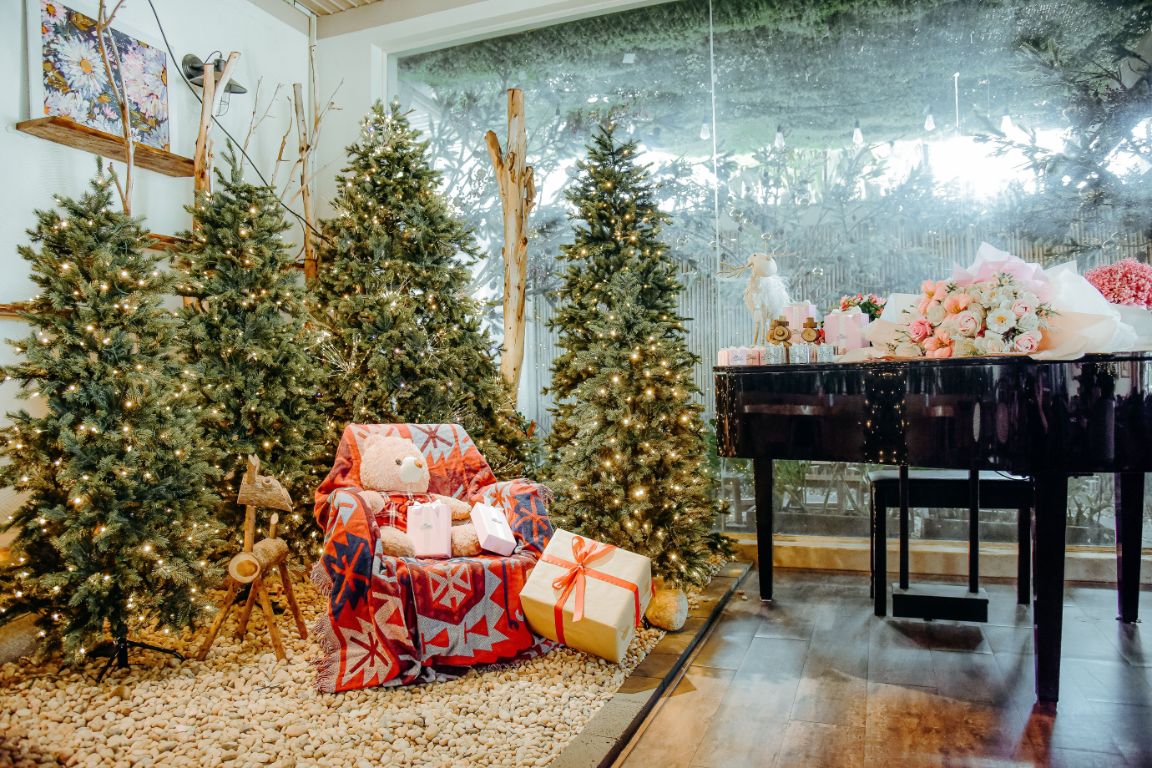
Figuring out how many Christmas lights you need is easier when you stop looking only at tree height.
A 7-foot pencil tree and a 7-foot full tree may need very different amounts of lighting. The same is true for sparse real trees, dense artificial trees, and trees decorated with cluster lights instead of ordinary mini lights.
This guide gives you a simple Christmas tree light calculator method you can use for almost any tree size.
How Many Christmas Lights Do You Need?
Enter your tree size and decorating style to get a practical starting estimate.
Start near the lower end, install the lights, then add more only if the tree still has obvious dark areas.
Cluster lights pack far more LEDs into a shorter cable, so comparing them with ordinary mini lights by bulb count can be misleading.
Check the product’s illuminated length and LED spacing. Install one section first, step back, and add another only if you want denser coverage.
Christmas Tree Light Calculator: Quick Estimate
For standard mini Christmas lights, a useful starting point is:
- Light coverage: about 75 lights per foot of tree height
- Balanced coverage: about 100–125 lights per foot
- Bright coverage: about 150 lights per foot
- Dense decorative coverage: 175–200+ lights per foot
This works best as a starting estimate. You should then adjust for tree width and fullness.
Simple Christmas Light Formula
You can estimate the number of lights using this basic formula:
Tree height × lights per foot = estimated light count
For example, a 7-foot tree with balanced coverage:
7 × 100 = approximately 700 lights
If you want a brighter tree:
7 × 150 = approximately 1,050 lights
Christmas Tree Light Calculator Table
| Tree Height | Light Coverage | Balanced | Bright |
|---|---|---|---|
| 4 feet | 300 | 400–500 | 600 |
| 5 feet | 375 | 500–625 | 750 |
| 6 feet | 450 | 600–750 | 900 |
| 7 feet | 525 | 700–875 | 1,050 |
| 8 feet | 600 | 800–1,000 | 1,200 |
| 9 feet | 675 | 900–1,125 | 1,350 |
| 10 feet | 750 | 1,000–1,250 | 1,500 |
| 12 feet | 900 | 1,200–1,500 | 1,800 |
These numbers assume standard mini lights. Cluster lights, large bulbs, and widely spaced strings need to be evaluated differently.
Step 1: Measure the Tree Height
Start by confirming the actual height of the tree rather than relying only on the size printed on the box.
Measure from the base of the visible tree to the highest branch you plan to light.
If the tree topper is not illuminated, do not include it in your measurement.
Step 2: Check the Tree Width
Width is the most important adjustment after height.
A slim tree has much less surface area than a wide tree.
Use this simple adjustment:
- Pencil or very slim tree: reduce estimate by around 20–30%
- Slim tree: reduce estimate by around 10–20%
- Standard full tree: use the base estimate
- Very wide or extra-full tree: add around 15–30%
Example: Slim 7-Foot Tree
Suppose the base estimate is 700 lights.
If the tree is very slim, reducing that by roughly 25% gives:
700 × 0.75 = about 525 lights
In practice, around 500–600 lights may be enough.
Example: Extra-Full 7-Foot Tree
Starting again with 700 lights:
Add roughly 25% for a very full tree:
700 × 1.25 = about 875 lights
If you also want a particularly bright look, moving toward 1,000 lights or more may make sense.
For a dedicated guide, see our 7-foot Christmas tree light guide.
Step 3: Decide How Bright You Want the Tree
There is a big visual difference between a softly lit tree and a dense showroom-style tree.
Minimal Lighting
Use around 50–75 lights per foot.
This works well when:
- The tree is sparse
- You use large ornaments
- You prefer a traditional appearance
- You want the tree itself to remain prominent
Balanced Lighting
Use around 100–125 lights per foot.
This is a practical range for most indoor trees.
Bright Lighting
Use around 150 lights per foot.
This creates noticeably fuller coverage.
Dense Lighting
Use 175–200 lights per foot or more.
This is better suited to highly decorative trees where lighting is one of the main visual features.
Step 4: Consider Branch Density
Dense artificial trees can hide many bulbs inside the branches.
That creates depth but increases the number of lights needed.
Sparse trees need fewer because more of each bulb remains visible.
If your tree has very dense foliage, adding around 10–20% to the estimate is a reasonable starting adjustment.
Step 5: Decide How Deeply You Will Place the Lights
If every light sits on the outside edge of the tree, you need fewer lights.
If you weave lights toward the trunk and back toward the branch tips, you need more.
Deep placement usually creates the better-looking tree because it adds:
- Inner glow
- Depth
- Fewer dark holes
- More dimensional lighting
If you plan to light deep into the branches, add around 15–25% more than a surface-only estimate.
A More Accurate Light Calculator Formula
For a more detailed estimate, use:
Base light count × width adjustment × density adjustment × brightness adjustment
You do not need extreme precision. The goal is simply to account for the biggest differences between trees.
Example Calculation for a Full 8-Foot Tree
Start with 100 lights per foot:
8 × 100 = 800 lights
The tree is full, so add around 15%:
800 × 1.15 = 920 lights
You want brighter coverage, so round up toward roughly:
1,000–1,100 lights
Example Calculation for a Slim 6-Foot Tree
Start with:
6 × 100 = 600 lights
Reduce by around 20% because it is slim:
600 × 0.80 = 480 lights
About 500 lights would be a sensible starting point.
How Many Lights for a 4-Foot Christmas Tree?
A typical 4-foot tree usually needs around 300–500 mini lights.
A small tabletop tree may need considerably fewer.
How Many Lights for a 5-Foot Christmas Tree?
For most 5-foot trees, around 400–600 lights provides balanced coverage.
A slim model may look complete with closer to 350–450.
How Many Lights for a 6-Foot Christmas Tree?
A standard 6-foot tree often works well with around 600–750 lights.
For brighter coverage, increase that toward 900.
How Many Lights for a 7-Foot Christmas Tree?
A full 7-foot tree typically works well with around 700–1,000 lights, depending on width and desired brightness.
Our dedicated 7-foot tree guide covers this size in more detail.
How Many Lights for an 8-Foot Christmas Tree?
Expect roughly 800–1,100 lights for a standard tree.
A very wide or highly illuminated tree may need 1,200 or more.
How Many Lights for a 9-Foot Christmas Tree?
A typical 9-foot tree may use around 900–1,200 lights.
Because taller trees often have wider bases, width becomes increasingly important at this size.
How Many Lights for a 10-Foot Christmas Tree?
For a standard 10-foot tree, around 1,000–1,300 lights is a useful starting range.
Dense decorative trees may use 1,500 or more.
How Many Lights for a 12-Foot Christmas Tree?
Large 12-foot trees can easily require 1,200–1,800 lights, depending on width and density.
For trees this large, check electrical capacity and manufacturer connection limits carefully.
How Many Feet of Christmas Lights Do You Need?
Bulb count is only one way to measure Christmas lights.
You should also check the illuminated wire length.
Two strings with 100 LEDs may have very different spacing.
For example:
- Closely spaced bulbs cover less distance but create denser light.
- Widely spaced bulbs cover more distance with fewer visible light points.
This is why the product's illuminated length matters.
Bulb Spacing Changes Everything
If one string has bulbs every 2 inches and another has bulbs every 6 inches, the visual density will be dramatically different even if both contain 100 bulbs.
When comparing products, check:
- Bulb count
- Bulb spacing
- Illuminated length
- Lead wire length
Mini Lights vs Cluster Lights
Standard mini lights are normally spaced evenly along a string.
Cluster lights contain far more LEDs in a shorter space.
Because of this, a raw bulb-count comparison is not very useful.
A 1,000-LED cluster string may cover much less cable length than 1,000 ordinary mini lights.
For cluster lights, see our cluster lights guide.
How Many Cluster Lights Do You Need?
With cluster lights, focus on:
- Total illuminated length
- Tree circumference
- How tightly you wrap the branches
- Desired brightness
One dense string may already create a very strong effect on a medium tree.
Install one section first before deciding you need another.
Large Bulbs Need Different Calculations
Larger Christmas bulbs create stronger individual points of light.
You generally need fewer of them than mini lights.
Large bulbs are also more commonly used outdoors than deep inside an indoor Christmas tree.
What About Pre-Lit Trees?
A pre-lit tree already has an established light count.
Before adding anything, turn the tree on in a darkened room and look for:
- Dark sections
- Uneven coverage
- Areas that feel too sparse
Only add more lights if the existing coverage actually needs improvement.
Can You Add Lights to a Pre-Lit Tree?
Yes.
Try to match:
- Light color
- Bulb style
- Brightness
- Wire color
Warm-white LEDs from different products can still look noticeably different when placed side by side.
Warm White vs Cool White
The required number of bulbs does not change much, but perceived brightness does.
Cool white can look sharper and more intense.
Warm white usually looks softer and more traditional.
For holiday styling ideas, read our warm white Christmas lights guide.
Do Multicolor Lights Need a Different Count?
Usually not.
The same basic coverage guidelines apply.
However, color variation can make the tree feel visually busier, so you may prefer slightly less dense coverage than with a single-color string.
How Many Strings Should You Buy?
Once you know the estimated bulb count, divide it by the number of bulbs on each string.
| Target Lights | 100-Light Strings | 200-Light Strings |
|---|---|---|
| 500 | 5 | 3 |
| 700 | 7 | 4 |
| 800 | 8 | 4 |
| 1,000 | 10 | 5 |
| 1,200 | 12 | 6 |
| 1,500 | 15 | 8 |
Always follow the manufacturer's instructions regarding how many strings can be connected together.
Buy a Little Extra
If you calculate that you need 700 lights, buying exactly 700 gives you no flexibility.
Having one extra compatible string can be useful if:
- The tree is fuller than expected
- You discover a dark section
- A string fails
- You want to add lights to nearby garland
Keep the packaging so unused sets can be stored separately if they are not needed.
Test Every String Before Decorating
Test all lights before putting them on the tree.
It is much easier to replace a faulty string on the floor than after it has been woven behind ornaments and ribbon.
How to Tell When You Have Enough Lights
Turn off the room lights and step several feet away.
Look for:
- Large dark patches
- Uneven brightness
- Sections with too many concentrated bulbs
- Visible horizontal rings
A balanced tree should look illuminated throughout rather than like several separate bands of light.
Move Lights Before Adding More
If one section looks dark, reposition the existing strings first.
Sometimes the problem is distribution rather than total bulb count.
Moving a section farther into or out of the branches can make a large difference.
Christmas Tree Light Calculator Summary
| Tree Type | Recommended Adjustment |
|---|---|
| Pencil tree | Reduce base estimate by 20–30% |
| Slim tree | Reduce by 10–20% |
| Standard tree | Use base estimate |
| Very full tree | Add 15–30% |
| Deep branch lighting | Add 15–25% |
| Minimal brightness | About 50–75 lights per foot |
| Balanced brightness | About 100–125 lights per foot |
| Bright display | About 150 lights per foot |
Common Calculation Mistakes
Using Height Alone
Height gives you a starting point, but tree width can change the required number considerably.
Ignoring Bulb Spacing
One 100-light string may cover much more distance than another.
Treating Cluster Lights Like Regular Strings
The LED density is completely different.
Buying Exactly the Calculated Number
A small amount of extra lighting gives you more flexibility.
Installing Everything on the Outer Branches
This may make the tree appear bright but flat.
Final Thoughts
A Christmas tree light calculator should give you a useful range, not pretend there is one perfect number.
Start with around 100 lights per foot for standard coverage, then adjust for tree width, branch density, desired brightness, and how deeply you plan to place the lights.
For most trees, those adjustments matter more than trying to hit an exact bulb count.
If you have a 7-foot tree, see our dedicated 7-foot Christmas tree lighting guide. For denser installations, read our cluster lights for Christmas trees guide.