
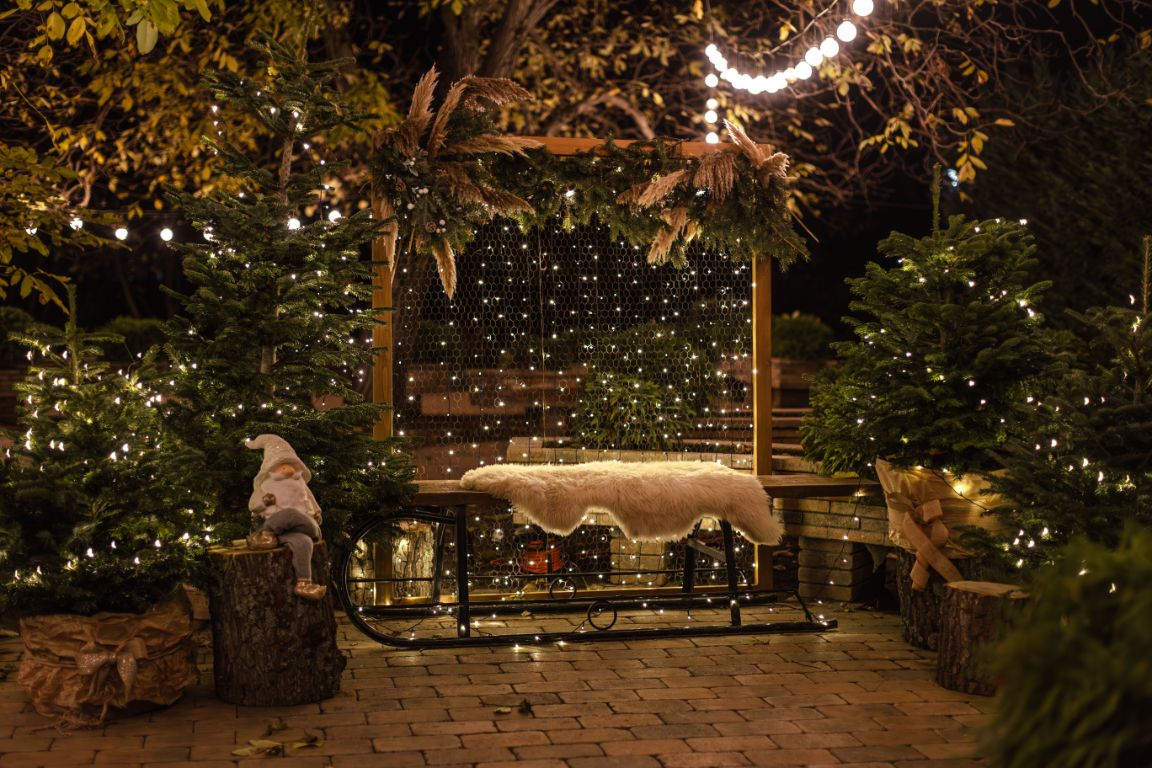
Warm white Christmas lights are one of the easiest choices when you want holiday lighting that feels traditional, comfortable, and less harsh than bright cool-white LEDs.
They work almost anywhere: Christmas trees, garlands, windows, porches, rooflines, wreaths, outdoor trees, and table decorations. But not every product labeled “warm white” looks exactly the same, and mixing several slightly different shades can sometimes make a display look inconsistent.
This guide explains what warm white Christmas lights actually look like, how they compare with other whites, and how to use them throughout your holiday decorating.
What Color Are Warm White Christmas Lights?
Warm white Christmas lights produce a softer white light with a noticeable yellow or golden tone.
The appearance is closer to traditional incandescent Christmas lights than the sharper blue-white appearance associated with many early white LEDs.
Warm white works particularly well with:
- Traditional green Christmas trees
- Wood furniture
- Gold ornaments
- Red decorations
- Natural garlands
- Wreaths
- Rustic and farmhouse decor
The result is usually more relaxed and traditional than a display based entirely on cool white light.
Warm White vs Cool White Christmas Lights
The main difference is the visual tone.
| Feature | Warm White | Cool White |
|---|---|---|
| Appearance | Soft, golden-white | Crisp, blue-white |
| Overall mood | Traditional and cozy | Bright and modern |
| Best with | Gold, red, wood, greenery | Silver, blue, white decor |
| Indoor trees | Very popular | Cleaner modern look |
| Snow and ice themes | Softer effect | Stronger icy effect |
| Vintage-style decor | Excellent | Less traditional |
Neither is inherently better. They simply create different styles.
Why Warm White Is So Popular for Christmas
For many people, Christmas lighting is supposed to feel warm rather than simply bright.
Warm white LEDs recreate some of the visual character associated with older incandescent holiday lights while still giving you the advantages of modern LED technology.
They also pair easily with most traditional Christmas colors.
That versatility makes warm white a safe starting point if you do not yet have a strong decorating theme.
Warm White Christmas Lights on a Tree
A Christmas tree is probably the most common place to use warm white lights.
They make green branches look richer and create a softer background for ornaments.
Warm white pairs especially well with ornaments in:
- Red
- Gold
- Bronze
- Copper
- Cream
- Burgundy
- Natural wood
If your tree uses silver, icy blue, and white ornaments, cool white may create a more coordinated look. But warm white can still work if you want to soften that palette.
How Many Warm White Lights Do You Need for a Christmas Tree?
The number depends on the height and fullness of the tree as well as how bright you want it to look.
A sparse tree needs fewer lights than a wide, dense tree of the same height.
Instead of relying only on tree height, consider:
- Tree width
- Branch density
- Bulb spacing
- Whether lights are wrapped deep inside the branches
- How bright you want the finished tree
We will cover this more precisely in our upcoming guide on how many Christmas lights you need for a tree.
Wrap Lights Deeper Into the Tree for More Depth
One of the easiest ways to improve a Christmas tree is to avoid placing every light only on the outside branches.
Run some lights closer to the trunk and others toward the branch tips.
This creates layers of light and makes the tree appear deeper after dark.
Warm white works particularly well with this technique because the inner glow resembles light coming from inside the tree rather than sitting only on its surface.
Warm White Cluster Lights for Christmas Trees
Cluster lights place many LEDs close together along the wire.
The result is much denser than a traditional string.
Warm white cluster lights are useful when you want:
- A very bright tree
- Dense sparkling light
- Less visible empty space between bulbs
- A more luxurious decorative look
They can also be useful on garlands and railings where you want a concentrated glow.
We will cover this style separately in our upcoming guide to cluster lights for Christmas trees.
Warm White Lights on an Artificial Tree
Warm white lighting can make an artificial tree feel softer and more natural.
If the tree is pre-lit, however, check the existing light color before adding more strings.
Two products can both be labeled warm white and still produce visibly different tones.
If one string appears golden and another looks closer to neutral white, the difference may become obvious once both are installed on the same tree.
Warm White Lights on a Real Christmas Tree
Warm white looks especially natural against real green branches.
The softer light also complements traditional decorations such as:
- Dried orange slices
- Pine cones
- Red ribbons
- Wooden ornaments
- Gold baubles
Follow the light manufacturer’s instructions and inspect electrical strings before installing them.
Warm White Christmas Lights for Windows
Windows are another good place for warm white lights because the softer color looks inviting from both inside and outside.
You can use them:
- Around the window frame
- Behind sheer curtains
- As curtain lights
- Inside a window wreath
- Around a small tabletop tree
If several windows face the street, using the same light color in all of them usually creates a more coordinated exterior appearance.
Warm White Curtain Lights
Curtain lights create many vertical strands hanging from one horizontal cable.
Warm white versions work well behind windows because they produce a softer background than multicolor or cool-white curtain lights.
They can also be used behind:
- Sheer curtains
- Party backdrops
- Dining areas
- Christmas photo areas
Avoid combining very dense curtain lights with several other bright decorations in the same small area.
Warm White Christmas Lights Around the Roofline
Warm white roofline lighting creates a classic exterior look.
It works particularly well on homes with:
- Brick
- Stone
- Wood siding
- Warm-toned paint
- Traditional architecture
You can use small mini lights for a subtle outline or larger bulbs when you want the roofline to be visible from farther away.
Warm White C9 Christmas Lights
Larger C9-style bulbs create a much bolder roofline than small mini lights.
Warm white C9 LEDs work well when you want a traditional large-bulb appearance without introducing multiple colors.
For product-specific options, see our C9 LED Christmas lights guide.
Warm White Lights for Garlands
Garlands often look particularly good with warm white LEDs because the golden tone complements greenery.
Use them around:
- Fireplace mantels
- Stair railings
- Front doors
- Porch columns
- Dining-room shelves
For a cleaner installation, choose green wire when the lights will be hidden inside dark greenery.
You can also see our pre-lit Christmas garland guide if you prefer garland with the lighting already integrated.
Warm White Lights for Wreaths
A few warm white LEDs can make a Christmas wreath visible after dark without overpowering the greenery.
Battery-powered versions are particularly convenient for doors because they eliminate the need to run a cable around the frame.
A built-in timer is useful so the wreath can illuminate automatically each evening.
Warm White Lights on Stair Railings
For indoor staircases, warm white lights can be wrapped through a garland along the railing.
Keep the installation tidy and make sure wires do not interfere with handrails or walking areas.
The lights should decorate the staircase rather than make it harder to use safely.
Warm White Lights Around Outdoor Trees
Warm white can make outdoor trees look elegant rather than highly colorful.
There are two common approaches.
Wrap the Trunk
Wrapping the trunk emphasizes the shape of the tree and works particularly well on trees near walkways or entrances.
Light the Branches
Adding lights farther into the canopy creates a larger illuminated silhouette.
This takes considerably more string length and installation time but produces a stronger effect.
Warm White Net Lights for Shrubs
Net lights are useful when you want evenly distributed lighting across bushes or hedges.
Instead of manually weaving a string back and forth, the net lays over the plant.
Warm white net lights can create a cleaner appearance than multicolor lights, especially when the rest of the house also uses warm white.
Warm White Pathway Lighting
Warm white holiday lights can also be used to define paths and entrances.
You might use:
- Lighted stakes
- Mini trees
- Lantern-style decorations
- Low string-light installations
Keep the actual walking surface visible and avoid placing wires where visitors may trip over them.
Warm White vs Multicolor Christmas Lights
Warm white creates a more unified, restrained appearance.
Multicolor lights create a more playful and nostalgic display.
| Style | Warm White | Multicolor |
|---|---|---|
| Traditional elegance | Excellent | Moderate |
| Playful family display | Good | Excellent |
| Easy color coordination | Excellent | Requires more planning |
| Works with greenery | Excellent | Excellent |
| Modern minimalist decor | Excellent | Less typical |
Your choice comes down to the overall style you want rather than one option being universally better.
Can You Mix Warm White and Multicolor Lights?
Yes, but separating them into zones usually looks better than mixing them randomly.
For example:
- Warm white on the house
- Multicolor on one outdoor tree
- Warm white around the doorway
- Multicolor in a children’s area
This allows each style to remain visually distinct.
Can You Mix Warm White and Cool White?
You can, but the difference is often more noticeable than people expect.
When placed directly beside each other, warm white can look yellow while cool white can appear blue.
If you intentionally want contrast, that can work.
If you want a seamless display, try to keep adjacent strings within the same white family.
Different Brands May Produce Different Warm Whites
“Warm white” is not a single exact appearance across every manufacturer and product line.
One string may look almost amber, while another may appear much closer to neutral white.
For large displays, it is often easier to:
- Buy matching sets together
- Use the same product line in adjacent areas
- Test different strings side by side before installing them
This matters most on rooflines and Christmas trees, where inconsistent colors are easier to notice.
LED vs Incandescent Warm White
Traditional incandescent lights naturally produce a warm glow.
Modern LEDs can reproduce a similar appearance, although the exact tone depends on the product.
LED Christmas lights are now common because they generally use less electricity and produce less heat than traditional incandescent strings.
If you are replacing an old incandescent display with LEDs, compare the color before purchasing many sets at once.
Steady vs Twinkling Warm White Lights
Steady warm white lights create a calm and traditional appearance.
Twinkling lights add movement and can make a tree or outdoor display feel more lively.
For a balanced setup, consider using mostly steady lights with a smaller number of twinkling or sparkling effects.
If every light flashes, the display can become visually busy.
Are Warm White Christmas Lights Good for Photos?
They can be, particularly for indoor Christmas scenes.
Warm white creates a softer holiday background around trees, fireplaces, and dining areas.
However, extremely warm lights can make photographs look more yellow than expected.
If photos are important, use warm white decorative lighting while keeping enough neutral room light to preserve natural colors.
Indoor vs Outdoor Warm White Christmas Lights
The color may look the same, but the product rating matters.
Do not assume an indoor string can be used outside simply because it uses LEDs.
For exterior installations, check that:
- The lights are rated for outdoor use.
- Power connections are suitable for the location.
- Extension cords are appropriate for exterior use.
- Controllers and power supplies are protected as instructed by the manufacturer.
Battery, Plug-In, or Solar Warm White Lights?
Battery-Powered
Best for wreaths, table decorations, small garlands, and areas away from outlets.
Plug-In
Best for trees, rooflines, long garlands, and larger displays that operate for several hours.
Solar
Useful where running a cord is difficult, particularly around landscaping.
Performance depends on the amount of daylight available for charging.
For dedicated exterior options, see our solar Christmas lights guide.
How to Make a Warm White Display Look More Interesting
Using only one color does not mean the display has to look flat.
Create variation through:
- Different bulb sizes
- Different heights
- Lit and unlit areas
- Garlands and greenery
- Wreaths
- Lanterns
- Tree lighting
- Subtle twinkle effects
Contrast between light and darkness is often more important than adding additional colors.
A Simple Whole-House Warm White Christmas Plan
If you want a coordinated exterior, try dividing the property into layers.
Roofline
Use warm white C9 or mini lights.
Front Door
Add a warm-white pre-lit wreath and garland.
Windows
Use warm-white candles, wreaths, or small strings.
Shrubs
Add warm-white net lights selectively.
Trees
Wrap one or two important trunks or branches rather than every tree.
Walkway
Use warm-white pathway decorations to guide visitors toward the entrance.
Repeating the same color throughout these zones makes the property feel coordinated even if each area uses a different type of fixture.
Common Warm White Christmas Lighting Mistakes
Buying Several Shades Without Testing Them
Different warm whites may become obvious once installed beside one another.
Using Too Much Light Everywhere
A completely illuminated property can lose depth. Leave some areas darker so important sections stand out.
Ignoring Wire Color
White wire may stand out against green Christmas trees and garlands. Green or dark wire is often easier to hide in foliage.
Mixing Very Warm and Very Cool Whites Accidentally
The contrast can look inconsistent if it was not part of the design.
Buying Indoor Lights for Outdoor Use
Always check the intended installation environment.
Warm White Christmas Lights: Quick Guide
| Location | Why Warm White Works | Useful Style |
|---|---|---|
| Christmas tree | Creates a soft traditional glow | Mini or cluster lights |
| Roofline | Clean, coordinated appearance | C9 or mini lights |
| Garland | Complements greenery | Mini or micro LEDs |
| Wreath | Subtle accent lighting | Battery LEDs |
| Windows | Looks welcoming from indoors and outdoors | String or curtain lights |
| Shrubs | Provides even decorative coverage | Net lights |
| Outdoor trees | Highlights trunks and branches | Outdoor string lights |
Final Thoughts
Warm white Christmas lights are popular because they sit comfortably between decorative and practical lighting.
They create a softer holiday atmosphere than cool white while remaining neutral enough to work with almost any traditional Christmas color scheme.
Use warm white as the foundation of the display, then create interest through different bulb sizes, greenery, wreaths, garlands, tree lighting, and selective twinkling effects.
If you want the entire home to feel coordinated, consistency matters more than using the largest possible number of lights.
Next, we will look at cluster lights for Christmas trees and when their much denser light pattern makes sense compared with ordinary Christmas light strings.
You can also browse our Event Lighting guides for more seasonal lighting ideas.